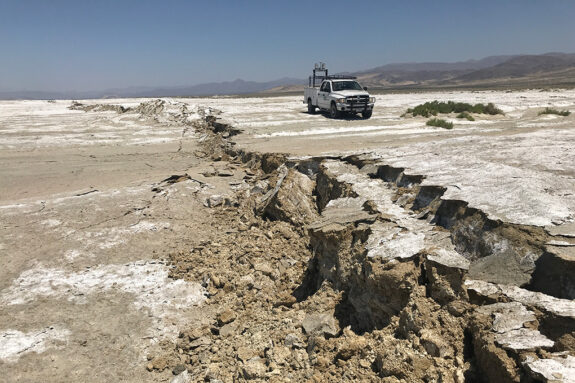
Eos: The Ridgecrest Earthquake Left Enduring Damage in Earth’s Deep Crust
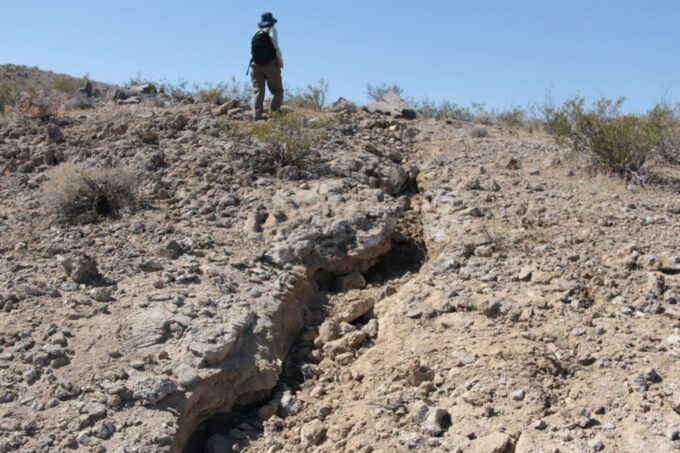
U.S. Geological Survey Pasadena earthquake response coordinator Sue Hough surveys rocks displaced by the magnitude 7.1 Ridgecrest earthquake, which struck Southern California in July 2019. New research shows that the upper crust recovered over several months following the quake, but the deeper crust remains damaged. Image credit: Susan E. Hough, USGS
Recently, the American Geophysical Union’s newsmagazine, Eos, spotlighted work by Earth, Atmospheric, and Planetary Sciences (EAPS) graduate student Jared Bryan and Victor P. Starr Career Development Professor of Geophysics William Frank, which appeared in the journal Science.
While investigating a new method to measure localized damage to the Earth’s crust after seismic events, the team discovered that shallow crustal areas recover quickly after an earthquake, regaining structural strength after fracture over months to a few years. In contrast, deeper crustal sections (>10 km) seem to exhibit “slow, evolving, and enduring damage.” What remains a mystery is the timescale for recovery of the deep crust—if it does at all.
Read the full article at Eos to learn more about how a simple test of a new technique uncovered this interesting result.