Eos: Visualizing and hearing the brittle–plastic transition
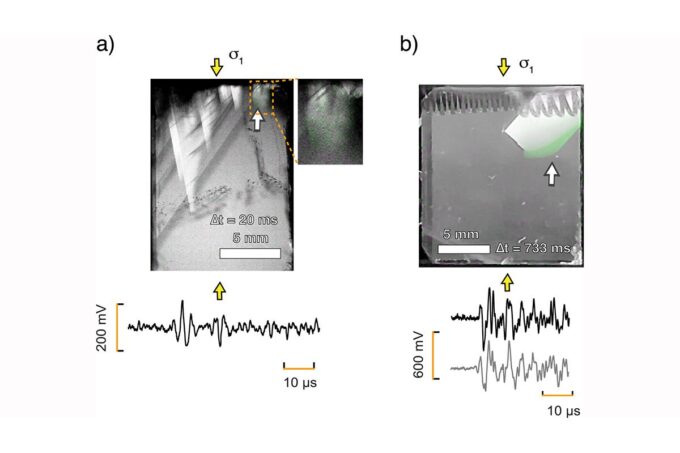
(a) False-color image of a slowly moving twin front recorded over 20 ms (experiment CC12). The moving twin is highlighted in green and marked by a white arrow (see inset and supplementary video). The corresponding ultrasonic signal is shown below. (b) False-color image from experiment CC6 showing the moving twin tip (green, white arrow). Two emitted signals recorded over about 733 ms are shown below. Credit: O’ Ghaffari et al. [2026], Figure 6
Recently, the American Geophysical Union’s newsmagazine, Eos, highlighted work by Earth, Atmospheric, and Planetary Sciences (EAPS) research scientist Hoagy O’Ghaffari and Associate Professor Matěj Peč, along with technical associate Ulrich Mok and collaborators from the Woods Hole Oceanographic Institution and Penn State.
A new paper published in the Journal of Geophysical Research: Solid Earth, details a set of novel experiments designed to capture simultaneous optical, mechanical, and acoustic measurements of crystalline materials as they deform and fracture. Using high-speed imaging and ultrasonic sensors, the group recorded how cracks and elastic “twin” deformations spread through calcite crystals at different sizes and speeds, finding that each mechanism produces distinct sound waves. By identifying these sound signatures, researchers can distinguish between brittle fracturing and plastic bending by analyzing acoustic signals.
Read the editors’ highlight at Eos to learn more about how these recent experiments offer new ways to use acoustic monitoring data to understand geologic materials and their behavior under stress.
Boom, crackle, pop: Sounds of Earth’s crust
October 9, 2023