Q&A: Jonathan Lauderdale on how ocean carbon sequestration changes under different glacial conditions
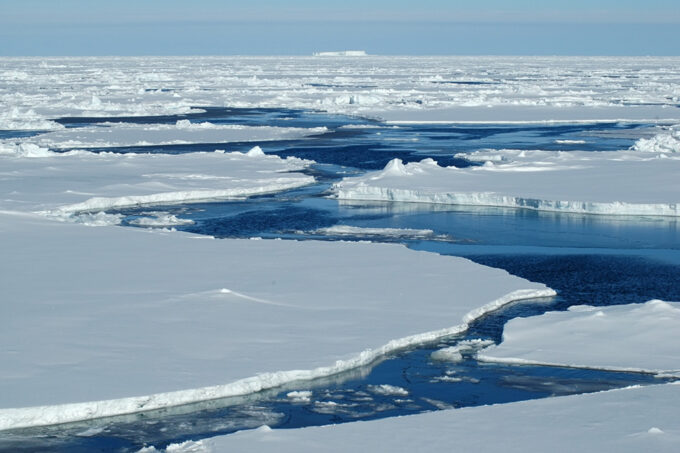
By coupling the expansion of sea ice and ocean circulation under glacial conditions, rather than looking at them individually, scientists are painting a larger picture of where carbon dioxide was stored in the ocean during global ice ages and how that may influence larger climate patterns. Image credit: Adobe Stock Images
Over the last 800,000 years, Earth’s history has been marked by dramatic shifts in climate, swinging from warm periods to cold, when large ice sheets covered much of the Northern Hemisphere and sea ice greatly expanded. The transition between the two climates is paced by the Earth’s orbit with respect to the sun, but changes in the amount of carbon dioxide, a greenhouse gas, also affects global temperatures. By understanding how CO2 is exchanged between the atmosphere and the ocean, scientists hope to apply that knowledge to future climate scenarios.
In a new Science Advances paper, researchers have taken an approach to understanding how processes that occur in the Southern Ocean around Antarctica during glacial periods, such as ocean cooling, sea-ice expansion, and changes in ocean circulation, contribute to global ocean carbon storage and atmospheric CO2 drawdown. By looking at how these climate processes work together, rather than how they act independently, they’re piecing together the complex, interconnected systems that feed into it. One of the authors on the paper, Jonathan Lauderdale, a research scientist in MIT’s Department of Earth, Atmospheric, and Planetary Sciences (EAPS) and MIT’s Center for Sustainability Science and Strategy (CS3), shares how and where the ocean stores carbon and why coupling glaciation processes changes the outcome.
Q: How does the ocean contribute to the global carbon cycle?
A: It’s a key player. Trying to figure out how CO2 gets into the ocean and stays there for thousands of years is a question that scientists have been working on for over 40 years. We generally think about three important ocean carbon stores. One is solubility. If you have a warm soda versus a cold soda, the fizzy one has more CO2 dissolved in it because it’s cooler. We can calculate how much more CO2 cold seawater can hold and, because cold waters are dense and sink, the carbon is stored in the deep ocean.
Second is biology. Phytoplankton take up CO2 near the surface when they photosynthesize, and then they die or get eaten by zooplankton and packaged into fecal pellets. These organic particles sink into the deep ocean and are converted back into dissolved CO2 by bacteria.
Third is disequilibrium. Solubility gives us an estimate of how much CO2 could be in the water if it is in long-term balance with the air, but there’s lots of other processes that affect CO2 levels, like biology, ocean circulation, and slow gas exchange with the atmosphere. Disequilibrium is the difference between how much carbon the water mass could hold and how much carbon is actually there.
Q: Are those processes different than the currents and overturning that happen on global scales?
A: These processes are tightly linked to ocean currents. The Southern Ocean Overturning Circulation is a major highway that brings carbon-rich waters back to the surface, where they interact with the atmosphere and phytoplankton. How long that water remains at the surface determines how much CO2 it releases and how much gets returned into the ocean interior as disequilibrium.
Q: When scientists have explored different mechanisms like seawater cooling, sea ice expansion, and ocean circulation change during ice ages, they looked at them separately from each other. Why is that?
A: Studying one process at a time is useful because it helps isolate cause and effect. Early papers were based on very simple, idealized box models, which couldn’t really capture the tight linkage between physical and biogeochemical processes that we can with our more complicated models today. The reverse is also true: We can run experiments using complex climate models, but then it’s very difficult to say what process is responsible for a result unless you only change one thing at a time.
Q: When you look at your model’s outcomes separately, what do you see?
A: When we change Antarctic sea ice on its own, we see a slight increase in atmospheric CO2, and the same thing happened when we just run with a glacial circulation. This might imply that sea ice and circulation are unimportant for ice age ocean carbon storage. When we run a “full” experiment with all three mechanisms—extensive sea ice, glacial circulation, and cooler temperatures—we see atmospheric CO2 decline, i.e. ocean carbon increases. This is consistent with what other scientists have been seeing in different models.
Yet, how the carbon was stored didn’t quite make sense to us because we saw only a small net increase in carbon due to solubility, which we expected to dominate, while most of the added storage appeared in the disequilibrium carbon pool.
Q: With coupling, how does this change?
A: When we coupled sea ice and circulation we saw a significant CO2 drawdown and the disequilibrium carbon fingerprint of our “full” glacial ocean. Cooling still matters, but it is not the complete picture; it’s like we now know how to get the right answer for the right reasons.
We can also explain why the disequilibrium change was so important: it depends on how long the water mass spends in contact with the atmosphere in the Southern Ocean. More sea ice or the glacial circulation on their own decrease exposure. Together, atmospheric exposure is significantly reduced, so there’s a small window for CO2 exchange. That’s why much more of the upwelled deep-ocean carbon is sent back into the ocean interior.
Of course, there are caveats, but our findings point to interactions among physical processes, like sea ice and circulation, as an important driver of ice age ocean carbon storage.
Q: There’s a lot of talk recently about the possibility of the Atlantic Meridional Overturning Circulation (AMOC) collapsing. If that happened, looking at these results, how might that alter current carbon sequestration?
A: We were concentrating on the Southern Ocean, but in our scenarios the AMOC did slow down. The ocean is like a layer cake, with North Atlantic waters above denser Southern Ocean waters. Our AMOC reductions caused the boundary between Southern Ocean and North Atlantic waters to get shallower. This is important because rapid mixing near the seafloor is another, albeit slower, way for carbon to escape from isolated Southern Ocean waters into the better-ventilated North Atlantic waters, and back to the atmosphere. Reducing mixing across the water-mass boundary by raising it slows that escape. That’s why sea ice alone didn’t lead to carbon drawdown—because mixing across the deep boundary kept the two waters connected. So even though you’ve got this lid of sea ice in the Southern Ocean that’s locally trapping carbon, it’s still got a route back to the atmosphere.
It’s difficult because climate is changing in other ways at the same time. On one hand, a collapse of the AMOC could shoal that water mass boundary and isolate the Southern Ocean waters more. On the other hand, warming and a decrease in Antarctic sea ice cover might increase exposure time, leading to ocean carbon loss instead.
Lauderdale coauthored the paper with EAPS Professor Raffaele Ferrari and Sandy Grégorio and Louis-Philippe Nadeau at the Institut des Sciences de la Mer, University of Québec at Rimouski, Canada.
This research was supported, in part, by the Natural Sciences and Engineering Research Council of Canada, the Canada First Research Excellence Fund, Schmidt Sciences, LLC and the MIT Climate Grand Challenge project Bringing Computation to the Climate Challenge (BC3), the Simons Collaboration on Computational BIOgeochemical Modeling of marine EcosystemS (CBIOMES), and the US National Science Foundation.