Q&A with Professor of the Practice Raymond Pierrehumbert: The geology of planetary atmospheres
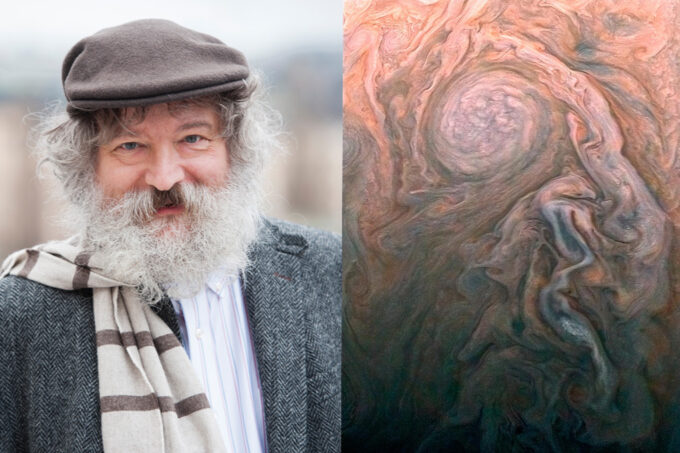
Professor of the Practice Raymond Pierrehumbert's career has taken him through many fields: fluid dynamics, atmospheric physics and now exoplanet atmospheres and climate. By studying the geology of planetary atmospheres, as he calls it, he hopes to develop a comprehensive understanding of atmospheric dynamics of planets both in and out of our solar system.
The Department of Earth, Atmospheric, and Planetary Sciences (EAPS) welcomed Raymond Pierrehumbert PhD ’80 as a Professor of the Practice on January 16. Pierrehumbert is the first Professor of the Practice in EAPS and the second in the School of Science. His career has taken him to several institutions, starting at MIT in the Meteorology Department, followed by Princeton and the University of Chicago before becoming the Halley Professor of Physics at the University of Oxford in 2015.
His expansive research history covers topics including fluid dynamics, paleoclimate, atmospheric physics and now exoplanet atmospheres and climate. Pierrehumbert is the author of the textbook Principles of Planetary Climate and is a fellow of the American Academy of Arts and Sciences, the American Geophysical Union (AGU) and the Royal Society. He was also a lead author of the Intergovernmental Panel on Climate Change (IPCC) Third Assessment Report.
Pierrehumbert took a moment to talk about his career trajectory, the fundamental questions he’s trying to answer about exoplanet habitability, and the importance of interdisciplinary research.
Q: You studied at MIT for your PhD and previously held a faculty position here. How does it feel to be back?
A: It is very exciting to be back, partly because it’s a satisfying feeling of closing the circle, but there’s so much energy and excitement at MIT. Here you have not only an extensive graduate curriculum, but more hours to teach [compared to Oxford]. I’ve always felt like the ideas I developed teaching have been driving my research for my whole career. Also moving (at least partly) back to the US at this moment, it feels better to be fighting for the future of science, and for sound climate policies.
Q: Usually a Professor of the Practice comes into this position with a lot of experience in their field. Let’s talk about the extensive career you’ve had so far because you didn’t initially start in exoplanet research, right?
A: Oh, not at all. I mean, exoplanet research didn’t exist for most of my career. When I was at MIT as a grad student, I was in Course 16 (Aeronautics and Astronautics), one of the homes of theoretical and experimental fluid dynamics. I worked on some fairly abstract general problems in stability theory. I took one meteorology course, which was taught by Glenn Flierl – who’s still here just down the hall from me – and the late Jule Charney. Jule was on my thesis committee and liked a term paper that I did, and the next thing I knew I had an offer of an assistant professorship in the Meteorology Department.
For 10 years or so I was doing the fluid dynamical side of meteorology and atmospheric science. Once I moved to Princeton, and was working with Isaac Held and Suki Manabe, who were doing global warming calculations, I discovered water vapor. It wasn’t until I moved to University of Chicago that I did work on global warming and paleoclimate.
Then when I was on sabbatical in France, I got hooked up with some people who were who were working on Mars, and then I started working on Venus and Titan, which has one of the most earth-like atmospheres. This was a whole new opportunity to do completely new things using fundamental physics, and so I jumped on the exoplanets. I always tell students that what we do is fundamental physics put together in different ways, so if you have a grounding in physics you can take advantage of the new opportunities that come along.
Q: Speaking of new opportunities, what fundamental questions are you trying to answer through your research?
A: We’re trying to understand the kind of planetary behavior that can lead to long-term habitability. Understanding both how critical things like carbon, water, and nitrogen get delivered to a planet and the [planet’s] ability to hold on to atmospheres is central. That’s one area where even James Webb data is not sufficient to test theories, so we’re laying the groundwork for the next generation of observations.
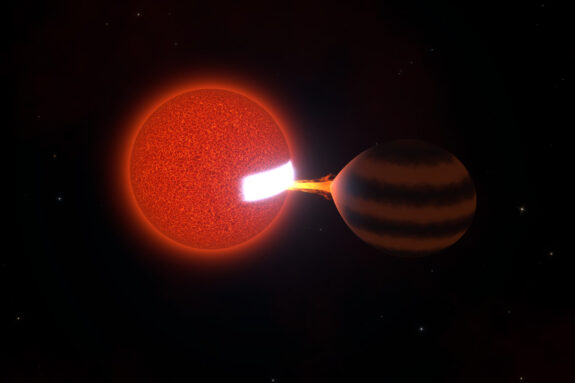
Meanwhile, the planets we do have a lot of data on are quite exciting. There are lava planets, which are so hot they have a permanent magma ocean on the day side maintained by heating from the star. These magma oceans evaporate rock vapors into the atmosphere. The atmospheric circulations push this at supersonic speeds onto the night side of the planets, and together with Wanying Kang we want to try to close the gap between various models of the atmospheric circulation and what we see from James Webb observations of lava planets.
The other class are sub-Neptunes, which are smallish planets, twice the size of Earth, but which have a much more extensive atmosphere. They’re still mostly rock but they have thousands or tens of thousands of times as much atmosphere as the Earth. One of the things I’m trying to understand is under what circumstances could one of these sub-Neptune planets have a habitable liquid water ocean. It involves reinventing the whole notion of habitable zones for a completely different kind of planet.
Q: How does the interdisciplinary nature of EAPS help you with your research?
A: The whole focus of my research, which I call geology of planetary atmospheres, is that you can’t understand atmospheres in isolation. Atmospheres are dynamic. They exchange with outer space and with geology. Having work on geology and geochemistry in the same department as atmospheres and planets is absolutely crucial to making progress.
Also we have people here working on deep time paleoclimate. The early Earth is like a different planet, but unlike exoplanets we can get sample rocks that tell us what was going on. There’s a lot of data that we can use to test, and if our theories don’t work for where we know a lot about the composition of the atmosphere, then there’s no point in trying to apply them in the less constrained cases of exoplanets.
Having the people I need to talk to or work with right in the Green Building is very good. The interdisciplinarity is organic; it’s good for the cutting-edge problems, whether it’s in geology or in exoplanets. You have to talk across the disciplinary boundaries if you want to have a hope at making progress on the big questions right now.