Richard Teague named 2026 NSF CAREER recipient

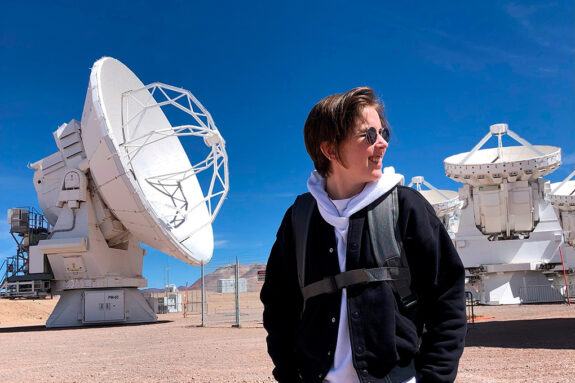
The National Science Foundation (NSF) has selected MIT Department of Earth, Atmospheric and Planetary Science (EAPS) Professor Richard Teague as a recipient of their prestigious Faculty Early Career Development (CAREER) program. The CAREER award, first started in 1995, seeks to support early-career faculty that serve as academic role models in both research and education.
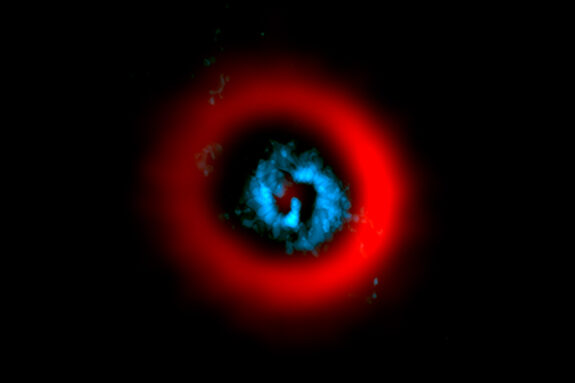
Teague’s proposal, “Revealing the Influence of Magnetic Fields During the Formation of Planetary Systems”, will investigate how widespread magnetic fields are in protoplanetary disks – collections of dust and gas surrounding stars that contain the building materials for planets – and how they affect disk structure and the planet formation process.
Research has shown that magnetic fields played a key role in the rapid formation of our own solar system. Teague, the Kerr-McGee Career Development Professor of Planetary Science, wants to “understand whether that was unique to our solar system or whether this seems to be a ubiquitous process.” So far, he had led a team in mapping the magnetic fields of a protoplanetary disk surrounding the star TW Hydrae.
“This CAREER is designed to extend from just a single sample to a larger sample and gives us the tools that we need to grow that in the future,” he says.
There are several approaches that Teague wants to take to expand their toolbox. One is first being able to detect if a disk has a magnetic field at all. He’s been able to do this with the help of molecular physicists by looking to see if the different molecule types in a disk are being excited by the presence of a magnetic field, which creates a detectable energy signature.
The next is being able to expand the search beyond disks that are only oriented face-on to Earth. Because disks are 3D structures, the emission signatures of their excited particle change over distance, adding a new layer of data to disentangle. Once they manage that, then they can apply some new analytical tools to refine and expand their interpretations of the data. By creating this analysis pipeline, they can optimize the observational data taken during their limited telescope time.
“The question of magnetic fields in planet formation has stagnated because it’s been so hard to make these measurements,” Teague says. “The award of a CAREER demonstrates that the work we’ve done showing these new ways of detecting the field have excited the community and they see this as a way that we can push the field forward.”
Another important component of the CAREER award is education. In addition to creating a planetary formation course for MIT’s OpenCourseWare, Teague is working with MIT’s Wallace Astrophysical Observatory to expand their public outreach programming. While Wallace offers tours and programming to local schools, it requires students to travel to the observatory’s location in Westford, MA. By purchasing portable telescope kits and training interested graduate students they can create astronomy lessons that can be brought to schools that otherwise would be unable to visit Wallace.
“We want to develop a model where we can actually go to the places that need the support,” he says.