New algorithm helps redefine our understanding of jet streams
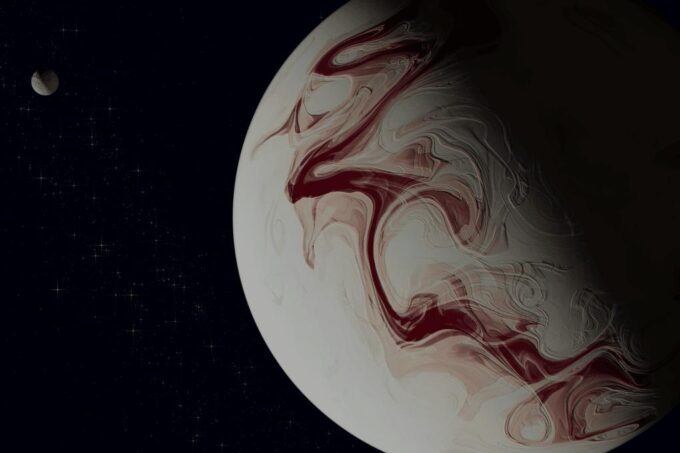
The identification algorithm JetLag uses a fresh approach to jet stream identification by looking at how these fast winds travel through the atmosphere over time. Image credit: Louis Rivoire
When winds blow over Alaska, where do they go? Much like the oceans, the atmosphere is made up of organizing currents that flow roughly from west to east known as jet streams. These narrow bands of strong winds flow at about 30,000 feet, or the cruising altitude of planes. They also play a critical role in guiding weather patterns by pushing warm and cold air that can whip up storms or stall systems from moving on.
But identifying a jet stream is easier said than done – they warm and break or become wavy and spiral. Temperature and season play a role in how strong they are. When scientists identify a jet stream traveling over Alaska and down to California, they rely on simplified assumptions of how a jet stream behaves to find them, and their results don’t always agree.
“They are tricky to identify because they are not fixed, clean lines,” says Class of 1947 Development Professor Talia Tamarin-Brodsky. “If you define them only by the strongest winds at any given moment, you can end up capturing short-lived jet streaks while missing weaker but more persistent features that still play an important role.”
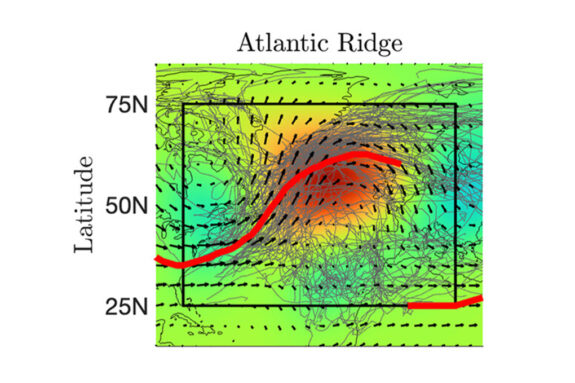
To help mitigate this problem Louis Rivoire, a former postdoctoral fellow in the Department of Earth, Atmospheric and Planetary Sciences (EAPS), has created an algorithm named JetLag that can identify the flow of jet streams over a period of days without relying on simplifying assumptions to create a more accurate trajectory-based map of their movement over time.
“[with JetLag] the way you describe it is rooted in theory, not on arbitrary choices to make it work,” he says. Additional authors on the paper, which was published in Communications Earth & Environment, include Jezabel Curbelo from the Universitat Politècnica de Catalunya in Barcelona and the Centre de Recerca Matematica and Marianna Linz PhD ’17 from Harvard.
When it comes to identifying jet streams, the traditional approach scientists use is by looking at a series of snapshots of different atmospheric locations and then picking out the jet in each picture to put together a larger map of its travels. But this approach requires making a lot of assumptions about what the jet stream looks like from snapshot to snapshot, and often only looks at the fastest, strongest winds.
Instead of taping together snapshots and interpreting where the jet stream is going, Rivoire has created a physics-based algorithm that releases weightless parcels like little balloons and watches them travel for several days, using the movement created by the winds to paint a picture of the jet stream.
“You link the snapshots together by letting the history of the wind tell you where and how far they went,” he explains. This new approach provides a more coherent view of where the streams go without having to make arbitrary decisions as to what is and is not a jet in each individual snapshot.
“That felt like a natural and physically meaningful way to think about jet streams, since one of their key roles is to organize transport and separate air masses with different properties,” says Tamarin-Brodsky, who provided useful insight for Rivoire while he was developing the methods used in the paper. “It can capture both strong and weak jets, is less sensitive to arbitrary parameter choices, and performs especially well in regions where the flow is more complicated.”
There are a few drawbacks to Rivoire’s method. Because it is modeling fictitious balloons traveling for several days, it is more expensive and time consuming to run than traditional methods that only take still snapshots. It also needs some work on summertime jet streams that flow closer to the poles, because these particular jets are harder to model due to their weakier and messier nature. But even with these drawbacks, the uses for it expand beyond just modeling the Earth’s jet streams.
“Because you don’t have to use parameters that are Earth-specific, a cherry on top with this method is you can do it anywhere where there’s an atmosphere,” says Rivoire. He is currently at the Weizmann Institute of Science working to refine the algorithm for applications on Earth, but notes that with additional changes it could apply to other uses such as exoplanet atmospheres or ocean currents.
“My hope is that the scientific community embrace this new view and treat it as an addition to what’s already being done,” he says, to which Tamarin-Brodsky agrees.
“I see it as complementary to existing approaches rather than a replacement for them,” she says. “I think it could be especially valuable for understanding jet variability, comparing methods more carefully, and improving how we study jet changes in a warming climate.”