Eos: Slow atmospheric circulations shape storm tracks and wave-breaking patterns
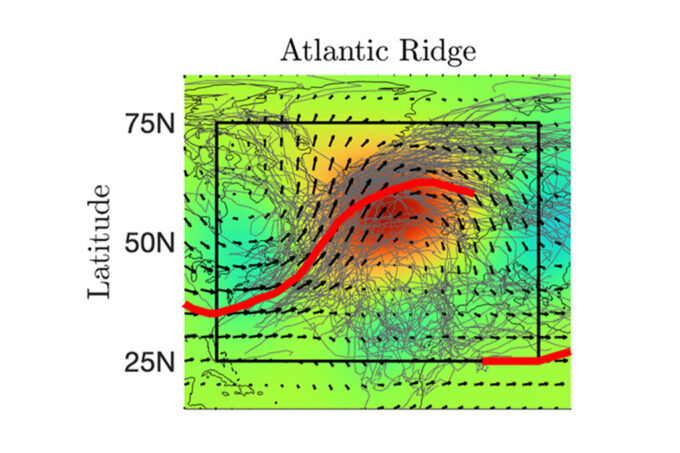
Tracks of low-level cyclones during different weather regimes in the North Atlantic. Shown are the 500 hectopascal (hPa) Geopotential height anomalies (colors) and total winds (arrows), tracks of low-level weather systems (thin lines), and the jet-stream axis (red line) for the Atlantic Ridge regime. Image credit: Tamarin-Brodsky et al. [2026], Figure 1a
The American Geophysical Union’s magazine, Eos, highlighted recent work by Earth, Atmospheric and Planetary Sciences Class of 1947 Career Development Professor Talia Tamarin-Brodsky that explores the connections between fast and slow parts of atmospheric circulations. In a paper published in AGU Advances, Tamarin-Brodsky and her fellow authors, Nili Harnik and Swinda Falkena, used 35 years of atmospheric data to derive a simplified wave-breaking equation that explains the distribution of Rossby wave-breaking events and how they connect to weather patterns influenced by jet streams.
Read the editor’s highlight at Eos to learn how these wave-breaking patterns steer storm tracks and offer insight into the interaction between daily weather systems and larger climate patterns.