Each year, Course 12 seniors present their thesis research to the department — a capstone on the way to completing their bachelor of science degree in Earth, Atmospheric and Planetary Sciences (EAPS). This year we had a class of 10 graduating across all four Course 12 concentrations (Earth Science; Climate, Atmospheres, and Oceans; Planetary Science and Astronomy; and Environmental Science), as well as one student from Course 1-12, the joint major in Climate System Science and Engineering shared between EAPS and the Department of Civil and Environmental Engineering.
A few of our newly-minted grads sat down to talk about their time in EAPS, their research, and advice for incoming students interested in the geosciences.
Kaylee Barrera
Evaluating Parametric Models of the Edge-on Protoplanetary Disk Gomez’s Hamburger
Advisor: Richard Teague
Summary of Research
Protoplanetary disks are the birthplaces of planets, and understanding their fundamental properties, such as their temperature structure, is critical for piecing together the planet formation process. My thesis investigates a specific disk, Gomez’s Hamburger, as its unique viewing geometry can be used to benchmark current disk models. I found that previously derived models were unable to reproduce our observed data, highlighting that, while these models have been successful in prior cases, they are still incomplete pictures of disk structure. Although this is in some ways a negative result, my thesis shows that there is still a lot left to learn about protoplanetary disks, and we are particularly excited about the prospect of using cutting-edge machine learning methods for future work.
Next Steps?
This fall, I will start my PhD in Astronomy and Astrophysics as an NSF Graduate Research Fellow up the street at Harvard University, where I will continue my research on exoplanets.
What was your favorite EAPS class and why?
Without a doubt, my favorite EAPS class is 12.411 Astronomy Field Camp. All my coursework in EAPS before 12.411 made me realize I enjoy astronomy, but it wasn’t until 12.411 that I actually solidified my goal to pursue astronomy as a lifelong career. Nothing has felt more breathtaking and sparked more curiosity than living nocturnally on a mountain for three weeks and looking up at countless stars. I will forever be chasing that high for the rest of my career!
What piece of wisdom can you share with incoming students?
Don’t be afraid to make yourself known. Whether that’s as simple as asking a question in lecture or cold emailing for a UROP with a professor you admire, a lot of opportunities come from learning how to advocate for yourself and having confidence in your abilities. You have to be your own cheerleader sometimes!
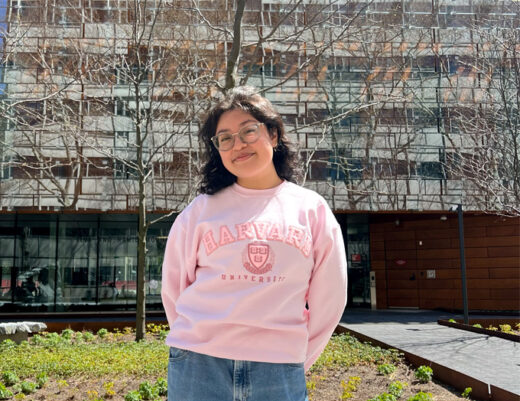
Victoria Martens
Observing, Modeling and Interpreting the Seasonal Succession of Phytoplankton in the Lower Charles River
Advisor: Mick Follows
Summary of Research
For the last few years, I have been taking weekly images of the phytoplankton in the lower Charles River with a microscope. My thesis involved building a nutrient-based chemostat model of the river and its plankton and determining whether the planktonic succession in the images matched what was modeled. This also allowed us to attempt to derive what factors are driving seasonal succession, and fueling harmful algal blooms, in the Charles.
Next Steps?
I’m going to France this summer to participate in an internship also involving plankton research. After that, I am thinking of becoming a veterinarian or getting a PhD in animal science.
What was your favorite EAPS class and why?
I really liked introduction to ecology. The teaching was great and I really enjoyed the subject material.
What piece of wisdom can you share with incoming students?
You can do hard things. Don’t just pick the easy route when it’s not really what you want. Challenge yourself to learn your limits.

Isabella Yeung
Evaluating the Sub-Seasonal Variability in Coastal Waters in Shellfisheries in Massachusetts, USA
Advisors: Ryan Woosley & Carolina Bastidas
Next Steps?
My goal is to contribute to marine conservation from a biological standpoint. In the Fall, I will be starting my MS in Marine Biology. (At the moment of writing this, I am undecided about which school.)
What was your favorite EAPS class and why?
My favorite EAPS class is definitely 12.001! Although I am not a geologist, I loved how hands-on the class was with the rock specimens, field trip, and mapping lab. This class gave me a deeper appreciation for the geological features we see every day. As an added bonus, I also went camping for the first time on the field trip! I highly recommend taking this class!
What piece of wisdom can you share with incoming students?
Don’t be afraid to explore your interests! It’s important to enjoy your time at MIT! Take classes you may find interesting and reach out to faculty! If it turns out you don’t like the subject matter, that’s alright! Figuring out what you don’t like is just as important as figuring out what you do like! Both will help guide you toward the opportunities and paths that best fit you.