Psyche spacecraft delivers Mars flyby data, detailed look at Mars’ magnetic signatures
During a flyby on May 15, the Psyche spacecraft used Mars as a stand-in to make the many scientific observations it will take when it arrives as the asteroid Psyche in 2029. Video credit: NASA/JPL-Caltech/ASU/True Story Films
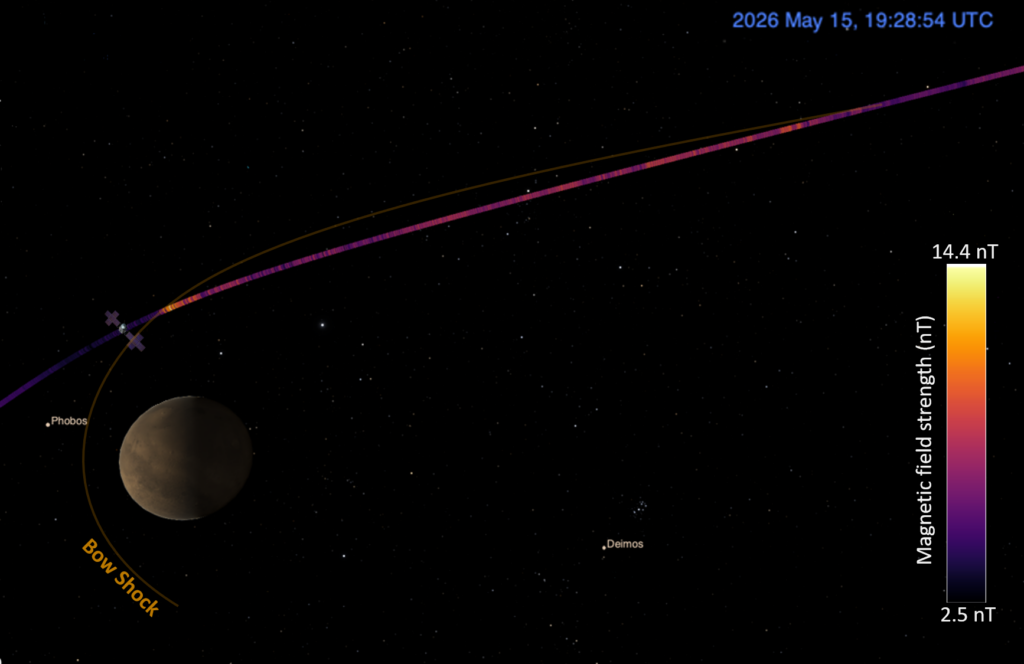
NASA’s Psyche spacecraft, on a journey to explore the metal-rich asteroid Psyche, completed a flyby of Mars on May 15. While the flyby was primarily planned to provide a gravity assist on its way out to the asteroid belt, its trajectory around Mars’ north pole offered a unique opportunity to test the spacecraft’s onboard instruments, including its magnetometer.
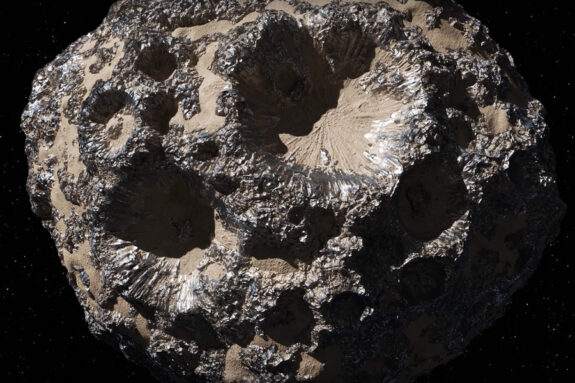
“The goal of the Psyche Magnetometry Investigation is to detect the magnetic field of the asteroid,” says MIT Earth, Atmospheric and Planetary Sciences (EAPS) Professor Ben Weiss, Deputy Principal Investigator of the mission and Magnetometry Investigation Lead. It is hypothesized that the asteroid Psyche is the remnant core of a larger planetary body.
While Mars doesn’t have a global magnetic field, it does produce magnetic activity as a result of its interaction with the solar wind – highly energetic particles that flow from the sun – which generates electrical currents in its thin atmosphere.
“The Mars flyby is like the case where Psyche doesn’t have its own intrinsic magnetic field, so we can learn in a broad sense what it looks like when the solar wind interacts with a body that doesn’t have its own internally generated field, but is electrically conducting,” says Weiss, who is also the Robert R. Shrock Professor of Earth and Planetary Sciences.
The Psyche spacecraft was able to pass the red planet at an area not heavily visited by other missions, giving the team the unique opportunity to get an up-close look at Mars’ bow shock, an area in the atmosphere that diverts the particles around it in the same way a ship’s bow splits water.
“I’m very excited to analyze the data,” says Hanying Wei, a researcher from the University of California Los Angeles who is working on data calibration for the magnetometer. “What we learn from the Mars flyby could pave the road for what we’re going to also learn at Psyche.”
The Psyche spacecraft’s magnetometer, a device used to measure magnetic fields, has been running since its launch in 2023 for several reasons. The first is to calibrate the device; in addition to taking external measurements, it also needs to take into account the magnetic field being generated by the spacecraft itself.
“It was a good exercising of our data pipeline to make sure everything was functioning as expected, and we got the results that we expected,” says Jodie Ream, a research scientist in EAPS.
Another reason it has been running since launch is to stress test the device, which was developed by the Technical University of Denmark (DTU). While they have a long history of developing scientific instruments, including ones in space, the Psyche magnetometer is the first instrument they’ve built going into deep space, which comes with its own set of challenges.
“We want to see how the instrument performance evolves over time and to make sure that the instrument is delivering the best possible quality of data,” says DTU Professor José M. G. Merayo, the Magnetometer Lead Engineer and Co-Investigator on the magnetometry team. One big concern is the extreme temperature fluctuations that can happen so the device needs to be able to handle them while also accounting for it in data measurements.
So far, the magnetometer is performing as expected and will continue to run while the spacecraft makes its journey to the asteroid Psyche, which is located in the asteroid belt between Mars and Jupiter. It is expected to arrive in 2029, and until then will be able to do “fun cruise science” as Ream puts it, which includes measuring the interplanetary magnetic field, coronal mass ejections, co-rotating interaction regions, and the spacecraft field.
The Psyche mission is led by principal investigator Lindy Elkins-Tanton ’87, SM ’87, PhD ’02 of the University of California, Berkeley Space Science Laboratory. NASA’s Jet Propulsion Laboratory, a division of Caltech in Pasadena, California, manages the project and provides mission operations.
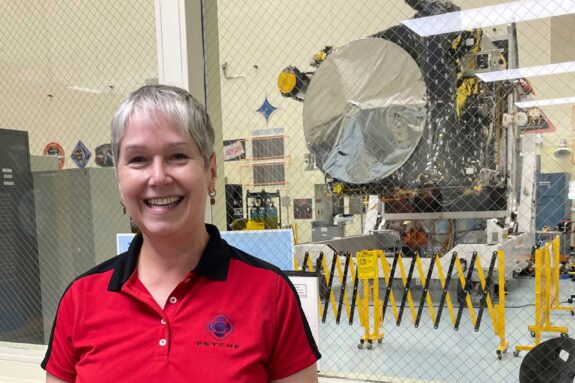
EAPS alumna Lindy Elkins-Tanton, lead of NASA’s Psyche mission, is ready to celebrate
October 10, 2023